
Facet Joint Pain and Focused Shockwave Therapy
Content and images courtesy of Helen How Clinic.
We treat facet joint pain, a common type of back pain, with focused shockwave therapy (F-ESWT) and EMTT. The information below is for patients and referring providers.
FOR PATIENTS
That Ache When You Lean Back? It May Be a Joint the Size of Your Thumbnail
Each level of your lower back has two small facet joints at the back of the spine. They're tiny, and the cartilage on them is only 1–2 mm thick. But the capsule around each joint is packed with nerve endings, so when these joints are compressed or irritated they can cause a lot of pain.
Signs It Could Be Your Facet Joints
- Pain mostly on one side of the lower back
- Worse leaning back, twisting, or standing and walking for a long time
- Stiff and sore getting up after sitting
- Can spread into the buttock or thigh, but usually stays above the knee
- Often eased by bending forward or sitting
If your pain travels below the knee, it's more likely coming from a nerve root (sciatica). That needs a different assessment.
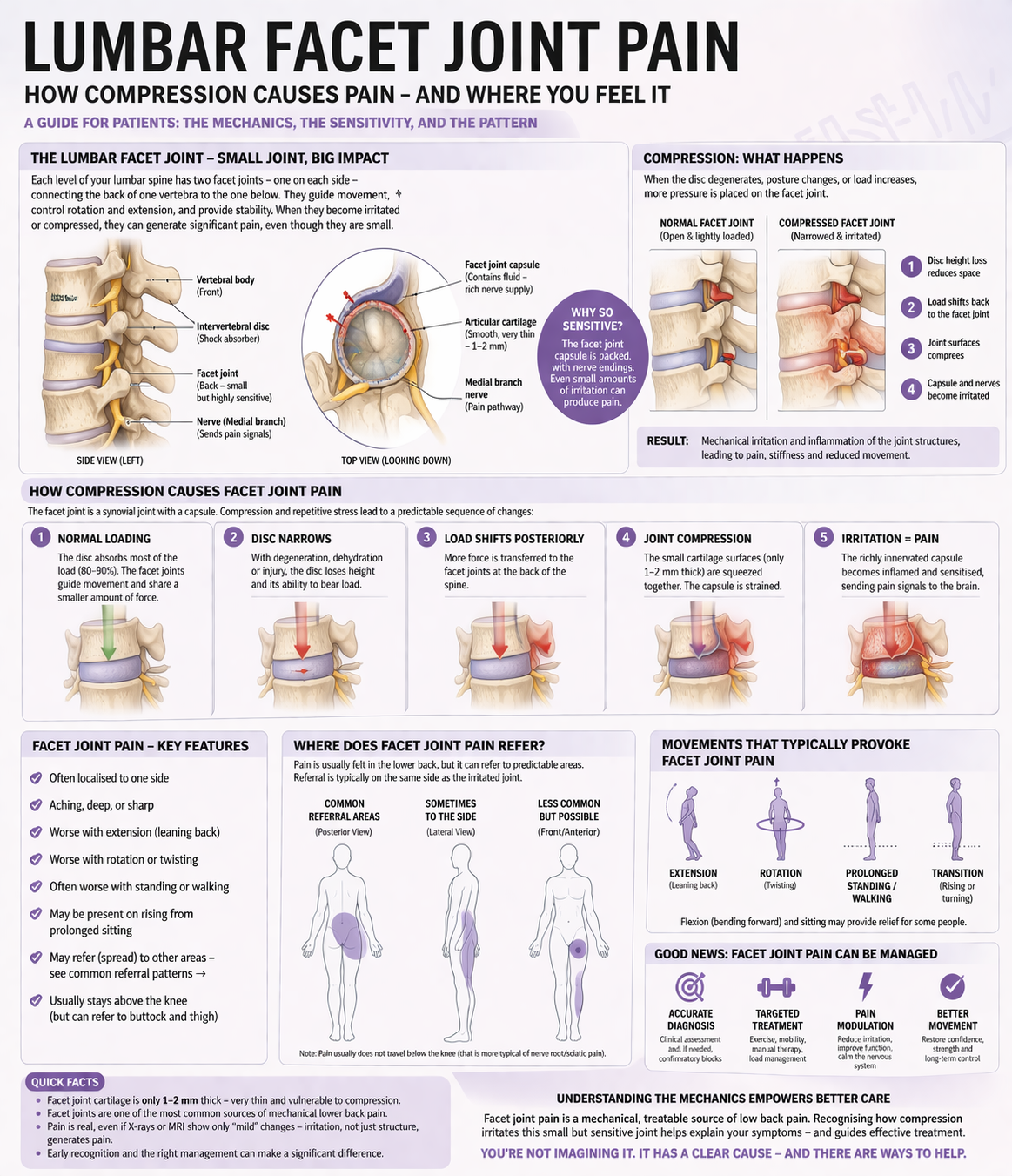
Courtesy of Helen How Clinic
Focused vs. Radial Shockwave Therapy
| Comparison Point | Focused ESWT | Radial Pressure Wave |
|---|---|---|
| Energy delivery | Energy converges at a specific focal point within the tissue | Energy disperses outward from the applicator across a broader area |
| Depth | Can target deeper or more precise structures depending on settings | Typically affects more superficial and broader regions |
| Best-use scenarios | More localized or deeper tendon and enthesis targets | Broader soft tissue regions and larger treatment zones |
| Terminology | Often referred to as focused extracorporeal shockwave therapy | Sometimes described as radial pressure wave therapy due to different physical properties |
| Why both matter | Allows for more precise targeting when needed | Allows for wider coverage depending on condition |
The Good News: It Can Be Treated
In 2025, a randomised trial published in the International Journal of Surgery treated 128 people with facet joint pain. Their diagnosis had been confirmed with a nerve block, and they had five weekly sessions of focused shockwave, guided by ultrasound, compared with a sham treatment. At 12 months the shockwave group had:
- Pain down by about 64%
- Disability scores down by about 42%
- Bone marrow oedema (inflammation in the bone) cleared on MRI in nearly 6 out of 10 people
To be fair to the evidence: this is one strong trial, not the final word. Wider reviews of shockwave for chronic low back pain show smaller benefits on average. Shockwave works best alongside exercise, mobility work and sensible load management, not instead of them.
Build the Support Around the Joint
Calming the joint down is only half the job. The other half is strengthening and stabilising the muscles that support your spine, so less load falls on those small facet joints. That's why I'd also recommend Pilates, either mat classes or reformer classes, with a well-qualified instructor. Tell them about your back so they can adapt the exercises, and go easy on movements that bend you far backwards at first.
One Important Exception
In young athletes, such as gymnasts, cricketers and dancers, low back pain that is worse leaning back can be a stress fracture of the spine (spondylolysis) rather than a facet joint problem. This needs proper imaging. There's encouraging early evidence for focused shockwave here too, particularly when the fracture is caught early.
Your pain is real, even if your scan shows only "mild" changes. Getting the right diagnosis is the first step.
Shoulder tendon conditions, including rotator cuff-related pain

For Referring Providers
The Smallest Joints in the Lower Back May Be Causing the Biggest Problems
Lumbar facet joints are one of the most common sources of mechanical low back pain. The articular cartilage is only 1–2 mm thick, and the capsule is richly innervated by the medial branch nerves. As discs lose height, load shifts backwards onto the facets, the joint surfaces compress and the capsule becomes sensitised.
Typical Clinical Picture
- Unilateral, deep aching low back pain
- Provoked by extension, rotation, prolonged standing/walking and rising from sitting
- Often eased by flexion and sitting
- Referral to buttock and thigh, usually not below the knee. Pain below the knee points more towards nerve root involvement
Focused Shockwave: The Evidence Is Strong
I work closely with the shockwave research, and it shapes how I treat in clinic. For facet joint pain, the landmark study is Nedelka et al. 2025 (Int J Surg) [1]. In 128 patients with facet joint pain confirmed by medial branch block, five weekly sessions of ultrasound-guided focused ESWT (Storz DUOLITH SD1, 0.35 mJ/mm², 1,200 shocks) were compared with sham. At 12 months:
- VAS pain reduced by 64.4%, a large effect size (Cohen's d = 1.12)
- ODI disability reduced by 42.3%
- MRI bone marrow oedema resolved in 58.8%, objective structural healing, not just symptom relief
Earlier work from the same group found ESWT outperformed steroid injection long term, with zero adverse events [2].
The Wider Evidence Base
Meta-analyses pooling up to 22 RCTs and 1,749 patients confirm significant reductions in pain and disability with ESWT for chronic low back pain, and no serious adverse events [3–5]. Focused ESWT produced significant improvement in pain and function across all included trials [6], with the best results in chronic presentations [7, 8]. Focused ESWT is also effective for sacroiliac joint pain [9, 10], an important differential when pain refers to the buttock.
Don't Miss Spondylolysis
In young athletes, extension-provoked low back pain may be a pars stress fracture rather than facet pain, and needs imaging. Iwata et al. 2025 reported 100% bone union in earliest and early-stage lesions treated with focused ESWT [11]. Early diagnosis matters.
Build the Support Around the Joint
Shockwave treats the joint; long-term control comes from strengthening and stabilising the spine. I recommend Pilates, mat or reformer, with a qualified instructor. The Cochrane review supports Pilates for improving pain and disability in low back pain [12].
Accurate diagnosis, targeted focused shockwave, then progressive loading.
SOURCES
References
- Nedelka T, Katolicky J, Nedelka J, et al. Efficacy of high-energy, focused ESWT in treatment of lumbar facet joint pain: a randomized sham-controlled trial. Int J Surg. 2025;111(7):4177–4186. https://doi.org/10.1097/JS9.0000000000002538
- Nedelka T, Nedelka J, Schlenker J, Hankins C, Mazanec R. Mechano-transduction effect of shockwaves in treatment of lumbar facet joint pain: comparative effectiveness evaluation of shockwave therapy, steroid injections and radiofrequency medial branch neurotomy. Neuroendocrinol Lett. 2014;35(5):393–397. https://pubmed.ncbi.nlm.nih.gov/25275264/
- Liu K, Zhang Q, Chen L, et al. Efficacy and safety of extracorporeal shockwave therapy in chronic low back pain: a systematic review and meta-analysis of 632 patients. J Orthop Surg Res. 2023;18:455. https://doi.org/10.1186/s13018-023-03943-x
- Wu Z, Zhou T, Ai S. Extracorporeal shock wave therapy for low back pain: a systematic review and meta-analysis. Medicine (Baltimore). 2023;102:e36596. https://doi.org/10.1097/MD.0000000000036596
- Yue L, Sun MS, Chen H, et al. Extracorporeal shockwave therapy for treating chronic low back pain: a systematic review and meta-analysis of randomized controlled trials. Biomed Res Int. 2021:5937250. https://doi.org/10.1155/2021/5937250
- Ferdinandov D. Focused extracorporeal shockwave therapy for the treatment of low back pain: a systematic review. Front Med. 2024;11:1435504. https://doi.org/10.3389/fmed.2024.1435504
- Walewicz K, Taradaj J, Rajfur K, et al. The effectiveness of radial extracorporeal shock wave therapy in patients with chronic low back pain: a prospective, randomized, single-blinded pilot study. Clin Interv Aging. 2019;14:1859–1869. https://doi.org/10.2147/CIA.S224001
- Lange M, Deventher N, Gosheger G, et al. Effectiveness of radial extracorporeal shockwave therapy in patients with acute low back pain — randomized controlled trial. J Clin Med. 2021;10(23):5569. https://doi.org/10.3390/jcm10235569
- Notarnicola A, Maccagnano G, Moretti L, et al. Conservative treatment of sacroiliac joint pain with extracorporeal shockwave therapy. J Biol Regul Homeost Agents. 2020;34(2):697–703. https://doi.org/10.23812/19-378-L-68
- Moon YE, Seok H, Kim SH. Extracorporeal shock wave therapy for sacroiliac joint pain: a prospective, randomized, sham-controlled short-term trial. J Back Musculoskelet Rehabil. 2017;30(4):779–784. https://doi.org/10.3233/BMR-160608
- Iwata S, Hatakeyama K, Kojima A, et al. Safety and efficacy of extracorporeal shock wave therapy for lumbar spondylolysis. J Spine Res. 2025;16(6):905–911. https://doi.org/10.34371/jspineres.2025-3029
- Yamato TP, Maher CG, Saragiotto BT, et al. Pilates for low back pain. Cochrane Database Syst Rev. 2015;(7):CD010265. https://doi.org/10.1002/14651858.CD010265.pub2